Silent Mode Until They're Back

Tonight's dinner was not the dinner I intended to make.
The plan had been 미역국—seaweed soup. I'd found a bag of frozen beef in the freezer earlier that day, labeled 국거리용, soup meat, and it felt like the universe was doing me a favor for once. My wife is in Korea visiting her parents with our daughter, and a bowl of 미역국 seemed like exactly the sort of thing that would make the house feel a little less empty.
Work had other plans.
An impromptu meeting stretched nearly two hours past where it was supposed to end, the way meetings do when someone decides now is the time to revisit a decision that was already made. By the time I was free, I was hungry and slightly annoyed that the beef was still a solid block. There hadn't been time to take the meat out to thaw before coming to the phone. I could have forced the issue and microwaved it into some compromised lederig texture—but I've ruined enough meals that way to know better. That's a good way to end up with something scorched on the outside and frozen in the middle, which is the kind of basic culinary regret that makes me want to take up intermittent fasting.
So there went the plan.
Meanwhile, my daughter had me on the phone.
She's almost eight, currently in Korea with my wife and the in-laws (I say that way, the in-laws mostly because by that time I was thoroughly annoyed by the whole situation—no soup for you!), and I haven't seen either of them in three and a half weeks. Normally our calls are quick; she says hi, tells me one thing that happened, asks when I'm coming, and we're done. Tonight was different. She was ehm...chatty? I mean more so than usual. The kind of conversation where every story leads to another story, and every question leads to three more, and you start wondering if she's actually going to let you go or if this is your life now.
I wasn't about to rush her off the phone though.
So while we talked, I wandered into the kitchen and started doing what Korean cooking has slowly, over almost a decade, trained me to do—open the fridge, grab whatever's there, and just... make something. In a lot of ways, this style of cooking, if you can call it that (more like scrounging) has kinda always been my MO in the kitchen. The formalized technique only became more crystalline after being exposed to Korean cuisine. My wife has a way of saubering up a meal out of nothing.
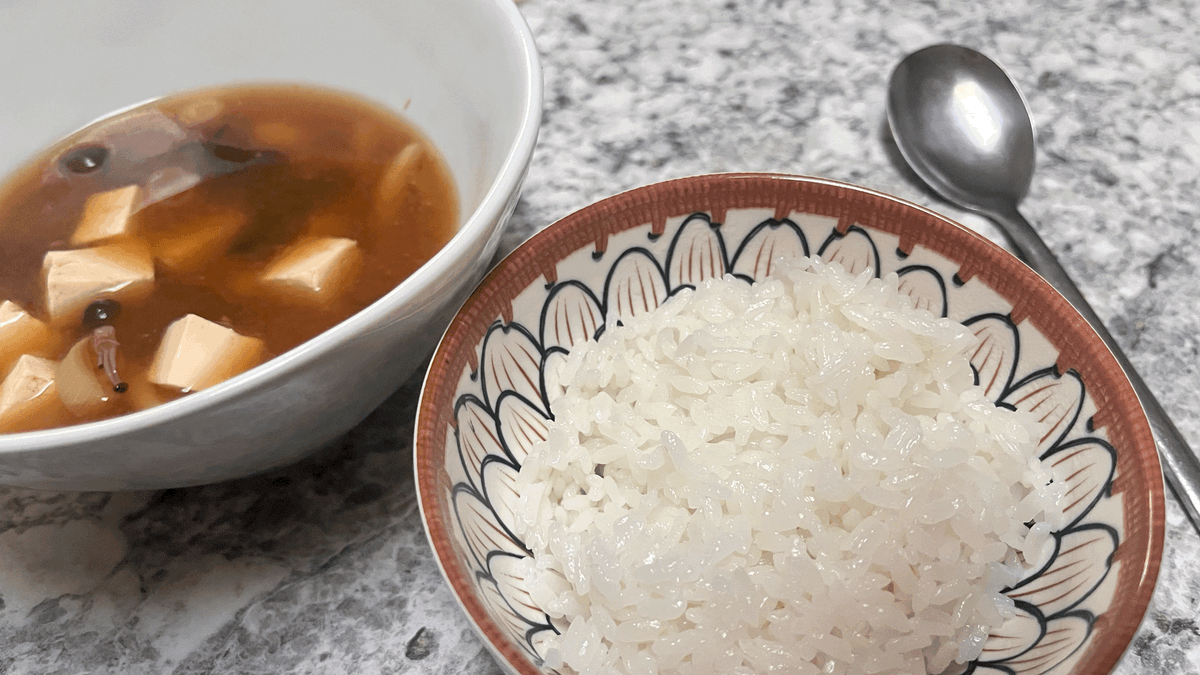
Anyway. Two liters of water. A couple large spoonfuls of 된장. Some 두부. A handful of 대파. A little 미역, because apparently my brain was not fully ready to let go of the seaweed soup idea even though the beef had long since vetoed it. Then I spotted the mushrooms.
Brown shimeji—the little clustered ones. Too bitter for my liking to eat raw, but in soup they turn into something otherworldly good. They do a lot of the heavy lifting the beef would have done, which I did not plan but will absolutely take credit for. [Is that how recipe development works? ...Accidentally?] I added them last because I wanted them to keep some texture.
The soup was finished by the time my daughter finished telling me whatever vital thing an almost-eight-year-old finds important—something about some new stationery, I think, or possibly the stick-on nails 할머니 bought for her (Those craft supply shops in Korea eat your time and money. IFYKYK). The rice cooker had finished too.
If there was one regret, it was the kimchi. My wife made a fresh batch just before leaving for Korea, and it's at that stage now where the 숙성 has done its work and everything has deepened into exactly the right place. I would have loved a little alongside the soup. But the giant 김치통 was sitting in the back of the fridge, and after the day I'd had, reaching past three containers and a jar of something I couldn't identify to wrestle it out felt like more commitment than I was prepared to make. (Sometimes dinner is about knowing which battles to not fight.)
The soup was going to have to stand on its own. It did just fine.
The mushrooms stayed firm. The 된장 brought richness without being heavy. The tofu rounded everything. And the 미역—the accidental holdover from the meal I didn't make—tied it together in a way that almost felt deliberate, which it absolutely was not.
I sat down with that and a bowl of rice, and—this is the part that's hard to explain to people who grew up eating the kind of rice I grew up with. Before Korea, rice was filler. It tasted like slightly starchy water and existed to take up space on a plate the way a throw pillow occupies space on a couch: technically present, functionally invisible. I never understood why entire cultures seemed so devoted to it; rice, that is. (Although there are entire strains of humans who follow the cult of pillows, I guess.)
Then I moved to Korea in 2014 and walked into a 김밥천국 (In hindsight, if I recall the specifics, it was called Orange 김밥, but I like the translation for 김밥천국 better, so let's just go with it.), and the rice was just... different. It had aroma. Sweetness. A warmth that made everything else on the table make sense. It wasn't carrying the food—it was the meal. One of those recalibrations where you realize you haven't been disliking a thing, you've been eating a bad version of it your entire life. I've never really gone back.
So tonight. A bowl of improvised mushroom 된장국. A bowl of rice. Five thousand miles between me and my wife and daughter. The house quiet in that specific way it gets when you're used to a kid filling up the silence and the kid isn't there.
The meal didn't feel lonely but there was something noticeably absent. It was filling but hollow at the same time. Comforting and simultaneously alienated. It was 된장국 but lacking my 김치. It was delicious but without my family.
At this point right now, I don't really know how to land the plane. I don't really have a tidy ending to add to this. I should probably end on a note about how comforting real rice can be. And remind myself that it's only a few more weeks before my girls will be back. That's something I can hang on to.